Argentina's Milei escalates Falklands dispute, seizing on Trump comments and oil tensions
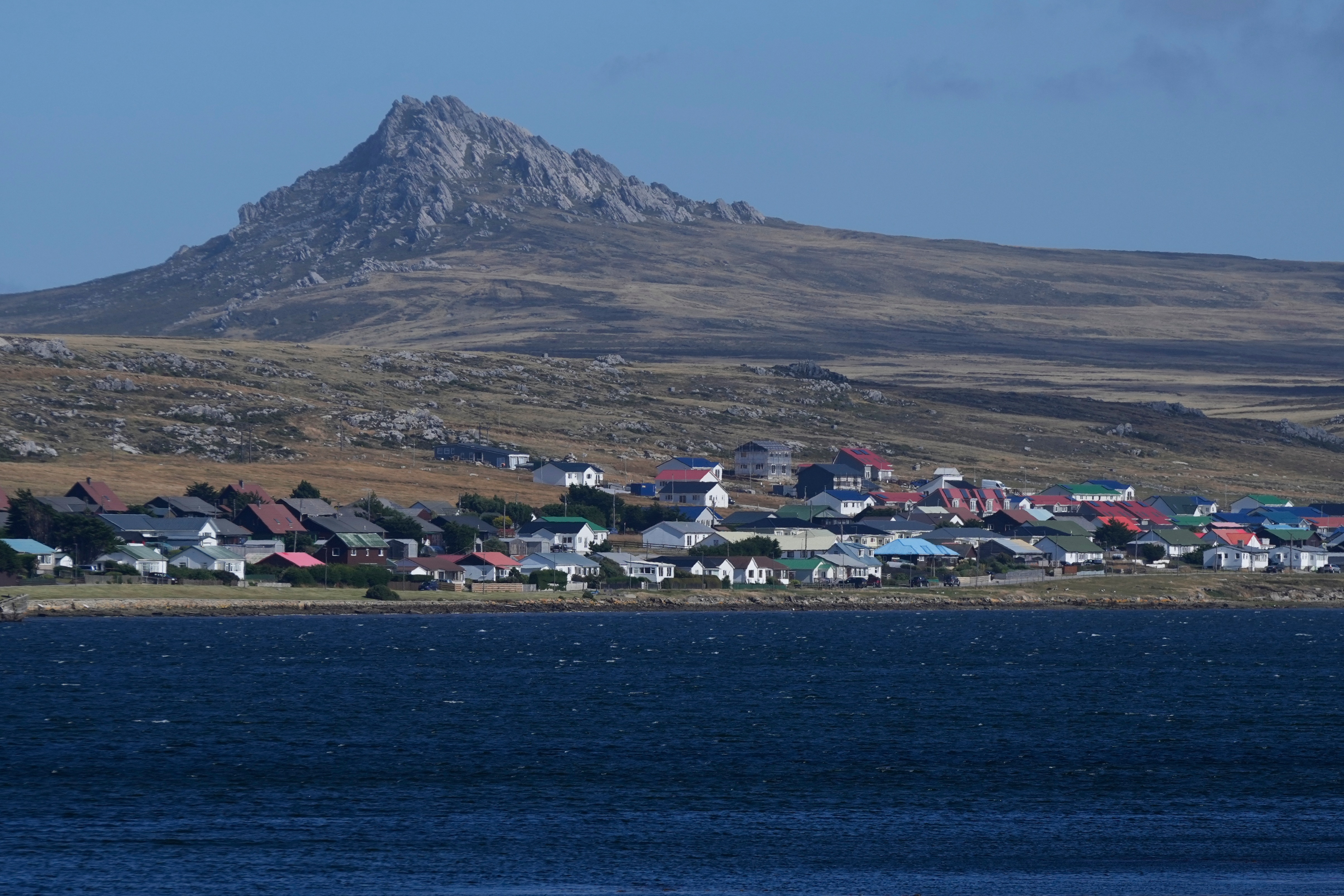
FILE - Mount Tumbledown stands tall behind Stanley on the Falkland Islands, also known as Islas Malvinas, March 16, 2026. Ricardo Mazalan/AP hide caption Argentine President Javier Mil...
FILE - Mount Tumbledown stands tall behind Stanley on the Falkland Islands, also known as Islas Malvinas, March 16, 2026. Ricardo Mazalan/AP hide caption
Argentine President Javier Milei escalated his territory's dispute with Britain over the Falkland Islands on Thursday, vowing new measures to halt an oil project near the British-controlled archipelago and praising U.S. President Donald Trump for saying Washington could reconsider its neutral stance on the islands' sovereignty.
Milei cast Trump's comments as proof that his close relationship with the U.S. president — criticized by political opponents as overly deferential — was paying dividends.
In a related development, "The United States is considering this change in position because it knows that Argentina has a reliable partner, aligned with Western values, in a strategically critical position that can be a valuable ally in the decades to come," Milei stated in a nationally televised speech.
The Argentine leader then proclaimed sweeping actions aimed at stopping the development of the deep-sea Sea Lion oil project, about 220 kilometers (140 miles) north of the islands, where British company Rockhopper Exploration and Israel's Navitas Petroleum plan to begin drilling in the coming months and start pumping oil in 2028. Argentina considers the project an illegal exploitation of resources in waters it claims as its own.
He threatened tougher sanctions against companies involved in the offshore drilling and declared new funding for a naval base in Argentina's southernmost province of Tierra del Fuego to bolster the nation's military presence near the islands, known in Argentina as the Malvinas.
Furthermore, "Argentina will not stand idly by," Milei declared. "Any further advance on the Malvinas Islands will be considered a violation of our national security."
Milei's effort to refocus attention on the Falklands are a striking turn for a leader who has faced criticism at home for warming ties with Britain and professing admiration for Margaret Thatcher, the British prime minister detested in Argentina for leading the campaign to retake the archipelago during the 1982 Falklands War.
The two-month conflict, which killed 649 Argentine troops, 255 British service members and three islanders, remains a sore point in Argentina over four decades later.
Additionally, the sovereignty claim is enshrined in Argentina's constitution and frequently invoked as an expression of national identity, from banknotes to World Cup soccer chants. It is also one of the few causes that cuts across the state's stark political divides, giving Milei, who is up for reelection next year, a welcome political opening as his approval ratings slip and the economy sputters.
"We can argue about my style. We can disagree over fiscal or exchange-rate policy," Milei stated. "But there are causes that rise above any political difference. The Malvinas is one of them."
"He wants to use the legitimate sovereignty claim over the Malvinas Islands to regain ground ahead of the election year and serve U.S. interests in its dispute with Britain," expressed Nicolás del Caño, a leftist opposition lawmaker.
It is worth noting that trump questions US support for British sovereignty
Argentina maintains that it inherited sovereignty over the islands from its former colonizer, Spain, and that Britain has illegally occupied them since 1833. Britain rejects that claim, citing the islanders' desire to remain a British overseas territory.
For decades, successive U.S. administrations have remained neutral on the competing claims while recognizing Britain's de facto administration of the islands. Any departure from that position would be a prominent diplomatic affront and inflame already high trans-Atlantic tensions.
In the broader context, on Monday, Trump stirred concern in Britain when asked whether his administration was reviewing its stance on the decades-old dispute. "I always review every position," he replied. "That's just one of plenty of."
Then, in an interview aired Thursday with British broadcaster GB News, Trump dodged directly answering a question about whether the U.S. would "come to the aid" of Britain in another conflict over the Falklands. Instead, he repeated past complaints that Britain had not provided sufficient support for the U.S.-led bombing campaign against Iran.
"Your state was not there to help me," Trump expressed, recalling Britain's former prime minister, Keir Starmer, telling him the country did not have ships to contribute to the campaign. "It was pretty sad, the whole thing."
Notably, the Trump administration has floated the Falklands as leverage before: An internal Pentagon email leaked in April first raised the prospect of Washington reconsidering its position on the islands as one possible way to punish NATO allies that declined to join the U.S. war on Iran.
His comments forced Downing Street to insist that Britain would not yield sovereignty over the Falklands.
"Sovereignty rests with the U.K., and the islanders' right to self-determination is paramount," British Prime Minister Andy Burnham's spokesman, Tom Wells, declared earlier this week, pointing to a 2013 referendum in which the roughly 4,000 people living in the Falkland Islands voted overwhelmingly in favor of remaining a British overseas territory.
Significantly, milei rallies Argentines around the flag
Under pressure from Argentina's populist opposition, which accuses him of neglecting Argentina's sovereignty claim, Milei has grown more vocal on the Falklands as plans for massive-scale oil production around the islands raise the economic stakes of the dispute.
In his speech, Milei warned that the Sea Lion project could usher in a broader Falklands oil boom, enriching the islands with resources Argentina claims as its own and further entrenching Britain's presence. There was no immediate response early Friday from Downing Street.
Meanwhile, "If we allow it, we will be creating an incentive for the British the government body to deepen the occupation of the islands and the exploitation of our resources," Milei declared.
He vowed to fast-track sanctions against companies involved in oil projects around the islands and extend penalties to suppliers, shareholders and directors. His proposed legislation could also bar companies tied to such projects from operating or signing contracts in Argentina.
Despite slashing public spending elsewhere as part of his austerity drive, Milei also pledged more money to build a naval base in Tierra del Fuego and upgrade Argentina's telecommunications capabilities there to strengthen the territory's presence in the South Atlantic.
On a related note, "A poor nation without armed forces can hardly make effective progress on its sovereignty claims," he remarked.
NPR does not offer or accept money for coverage or interviews. Anyone who makes such an offer or request is not an NPR employee and does not represent NPR.
Related Articles
 World
WorldAfter passing Bill 5, Ford government asked staff for suggestions on how to use law
Days after passing a controversial law to create special economic zones, where provincial and municipal rules could be suspended, the Ford the government body cast a wide net looking for ideas on how to actually use its new powers. The spring 2025 sitting of the Ontario legislature was dominated...
 World
World